
Chip-Tools
ECU identification, DTC read/clear and Live Data on Ford/Mazda
Ford/Mazda
Interface Classic
Diagnostics
Basic
⏱ 10-30 min
7 steps
The three basic diagnostic functions: reading the ECU identification (hardware variant, software variant, calibration level), reading and clearing fault codes, and watching live parameters. The identification is essential when you have to replace a damaged ECU with a compatible used one.
Required licences
- —
Hardware / cables
Procedure
- Connect the AVDI, start the software and select the correct vehicle context, then pick the control unit you want to interrogate from the list.
- Open the identification function ("ECU identification"): the software shows the module's hardware variant, software variant and calibration level.
- Note or save this data BEFORE ordering a replacement part: when you need a used ECU to replace the damaged original, the hardware, software and calibration level have to match, otherwise the module will not work properly on the vehicle.
- Move to the "Read / Clear DTC" function to read the selected ECU's fault memory: note the codes and their status before you clear anything.
- Repair the physical fault, then clear the DTCs. Read again straight afterwards: codes that come back immediately are live faults, not history.
- Use "Live Data" to view the ECU's measured values in real time and check how the sensors/actuators behave with the engine running or the ignition on, so you can confirm the repair has done its job.
- For a full picture of the vehicle, repeat the DTC read across all the modules with "Scan all" rather than going ECU by ECU.
Reference screenshots
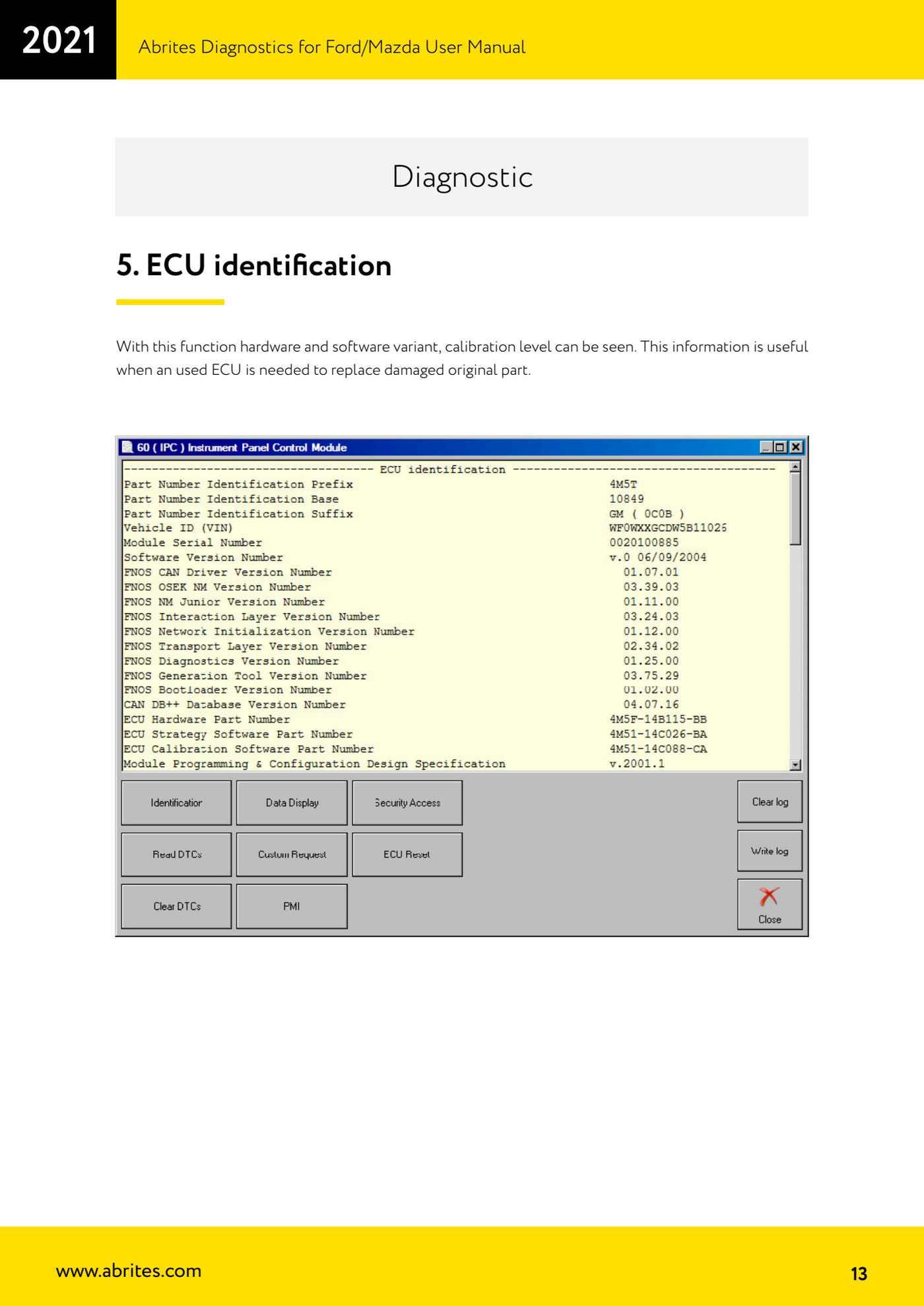
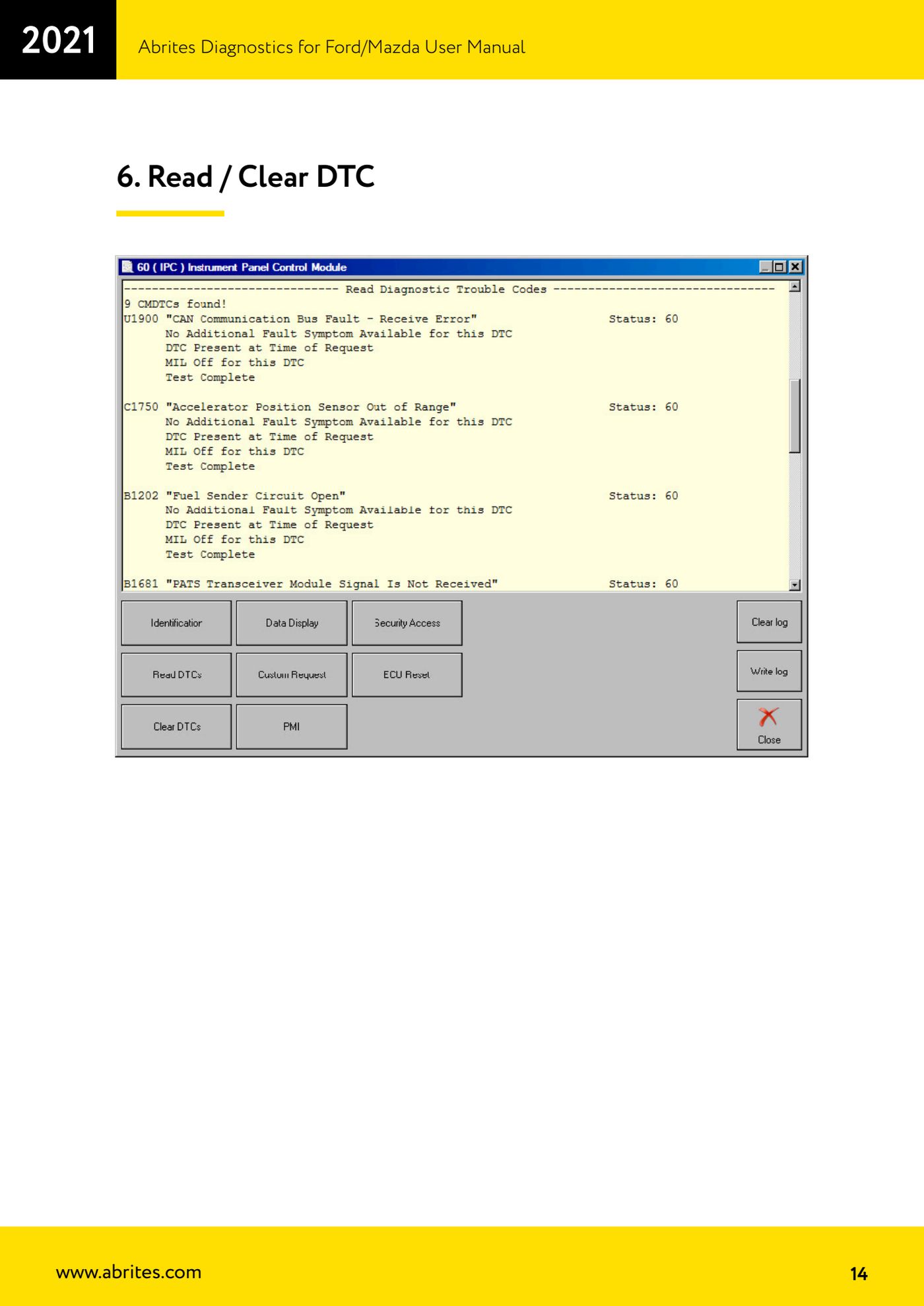
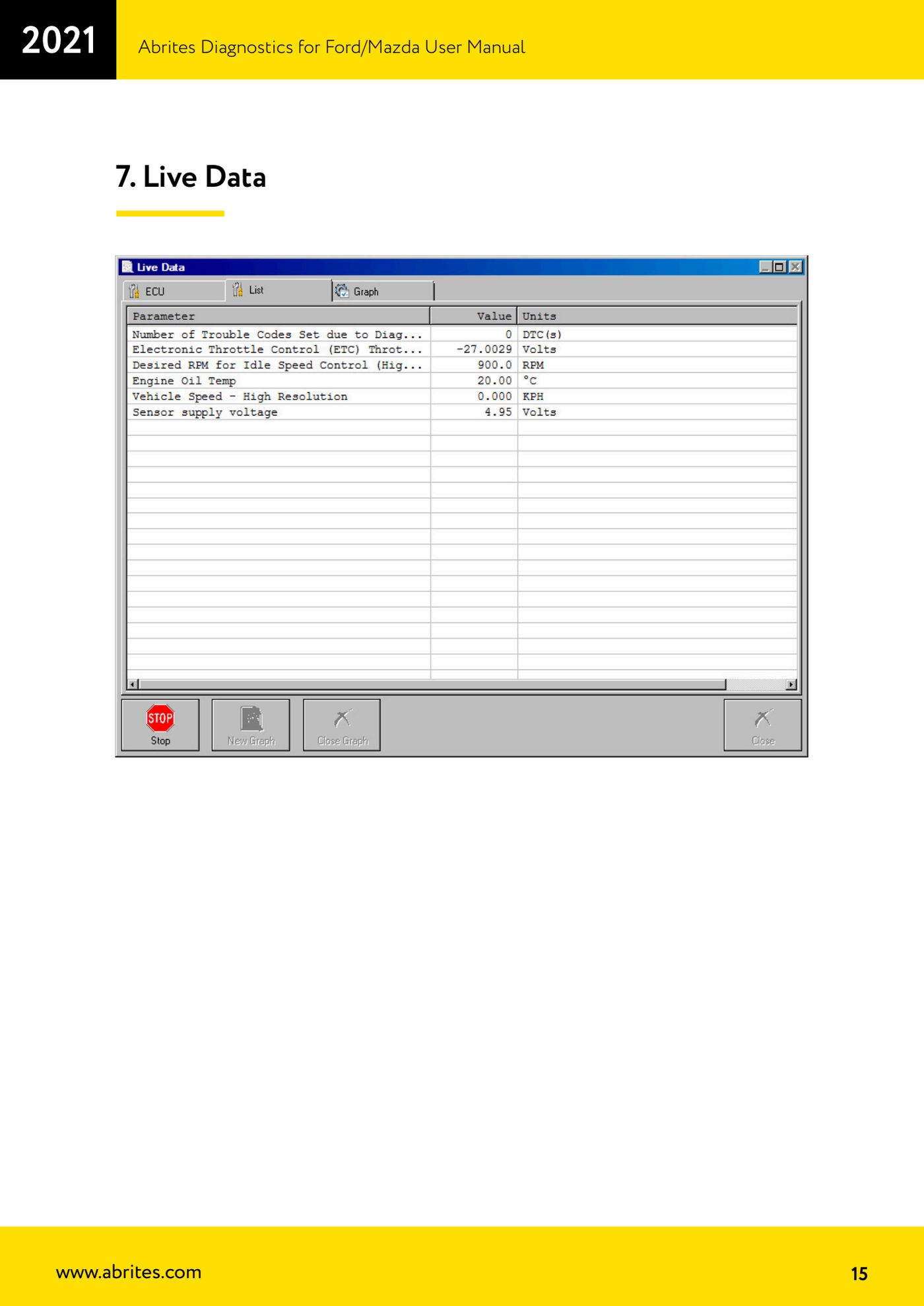
Source: Manuale Ford/Mazda, parte 1 di 2, cap. 5-7 (p.13-15) · ⏱ estimated time 10-30 min
← All Abrites guides Hardware catalogue
More guides Ford/Mazda
- Starting Abrites Diagnostics for Ford/Mazda: vehicle context and ECU scanning ("Scan all")
- Getting to the Ford/Mazda "Special Functions": Memory Read/Write and Key Learning
- PATS Key Learning: adding keys on Ford/Mazda (including with the alarm triggered)
- Key programming on Mazda CX-30 and Mazda 3 from 2019 with special function MZ001
- Ford key programming from 2021 (F-150, Maverick, Mustang Mach-E, Transit): incode from the outcode or bench read of the BCM with the ZN085
- PATS Erase All Keys: erasing all keys from the Ford/Mazda PATS memory
- PATS Initialization: matching the PCM to the instrument cluster (IPC/HEC), BCM or FIP on Ford/Mazda
- Spare Key Programming and Unlimited Key Mode: enabling/disabling Ford/Mazda key programming
- PATS OUT/IN code calculator for Ford/Mazda IDS (SINGLE xx40 and DOUBLE xx44 outcodes)
- VID block (Vehicle Identification Data) in the Ford/Mazda PCM: reading and configuring parameters
- Supported protocols and OBDII pins on Ford/Mazda: HS-CAN, MS-CAN, K-Line and J1850 PWM
- Ford PMI (Programmable Module Installation): transferring As-Built data to a new module