
Chip-Tools
Scanning control units, identification, actual values and reading/clearing DTCs
Porsche
Interface Classic
Diagnostics
Basic
⏱ 10-30 min
11 steps
This is the basic diagnostic job: pick the model, scan every control unit that can be fitted to that car, then go into the individual unit to identify it, read actual values and read or clear the stored faults.
Required licences
- —
Hardware / cables
⚠ WarningNot every unit accepts a broadcast fault clear, which is why "Clear all DTCs" connects to each control unit one at a time. The scan only uses the protocols set in the options, so if a unit doesn't show up, check the protocol configuration first.
Procedure
- Plug the interface into the OBDII socket and start "ABRITES Diagnostics for Porsche".
- On the main screen pick the vehicle configuration from the "Vehicle selection:" drop-down. The list of control units that can be fitted to that vehicle type appears below.
- For a full scan press "Scan all" in the "Broadcast" panel: the software tries to connect to every control unit in the list using only the protocols selected in the options.
- For each unit found you get the unit name, the protocol the diagnostic connection was established with (CAN ISO TP, CAN TP2.0, etc.) and the number of stored DTCs.
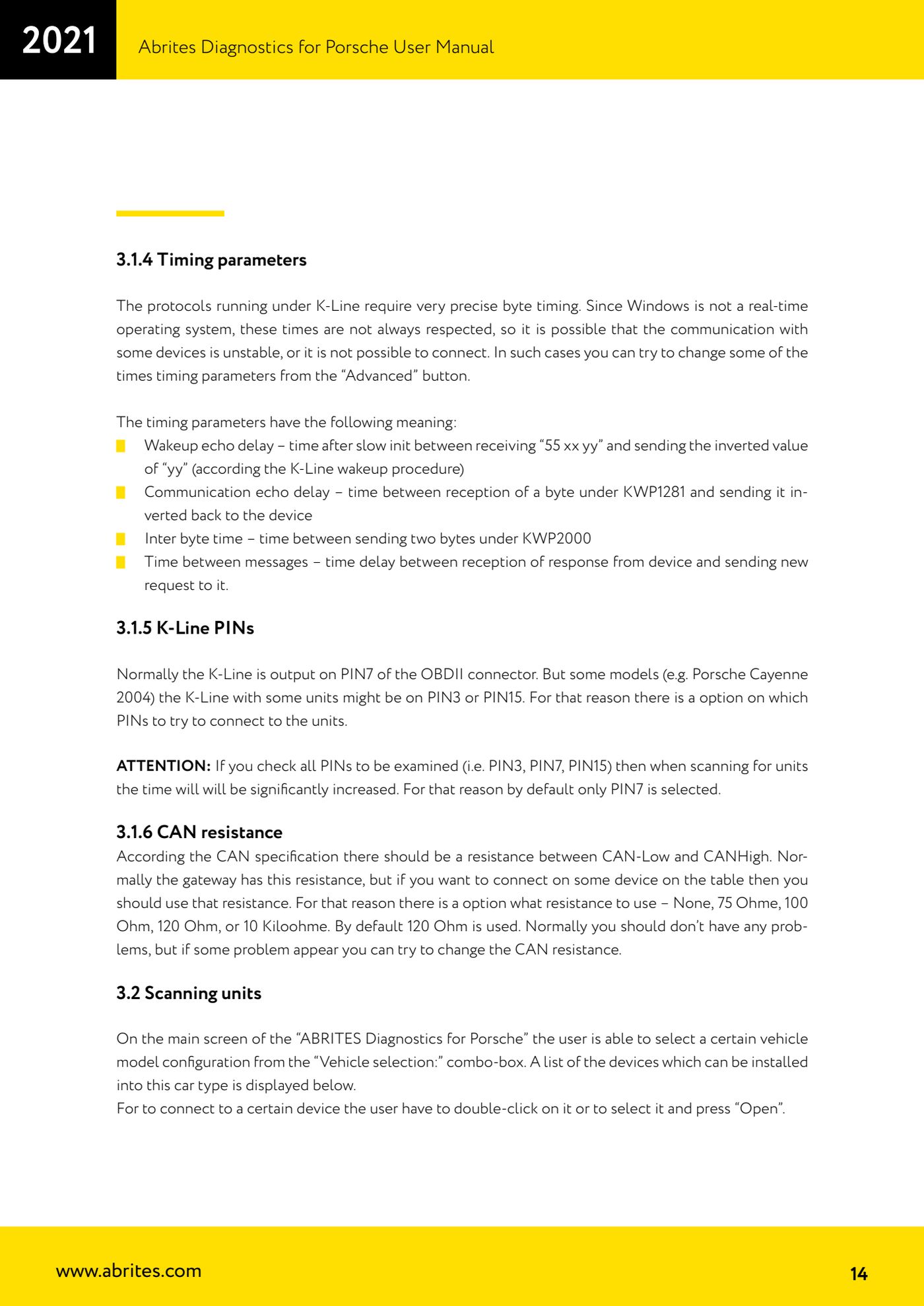
- To enter a control unit, double-click the entry or select it and press "Open": the standard diagnostic requests window opens.
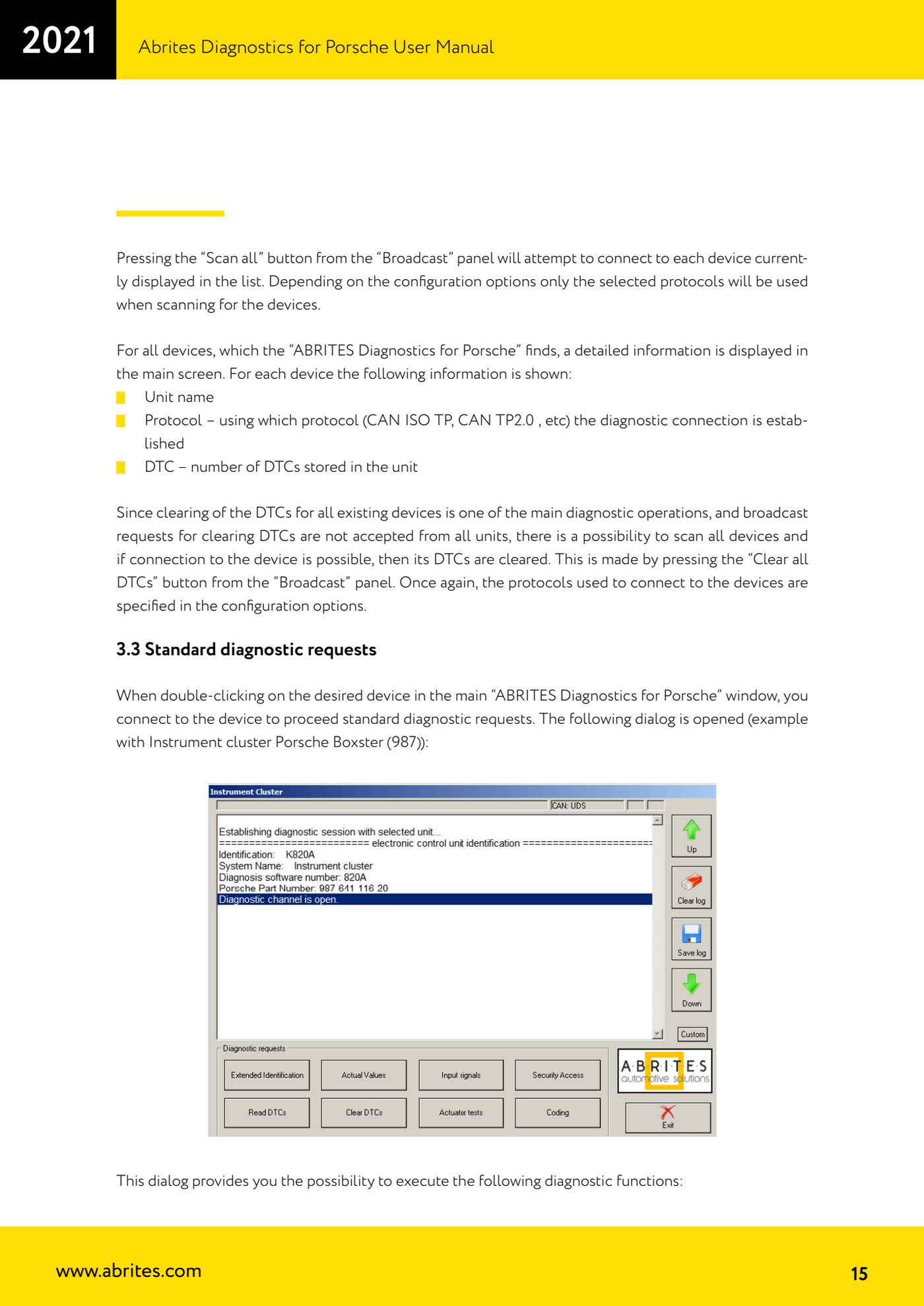
- Press "Extended Identification" to get the control unit identification and the VIN, if present.
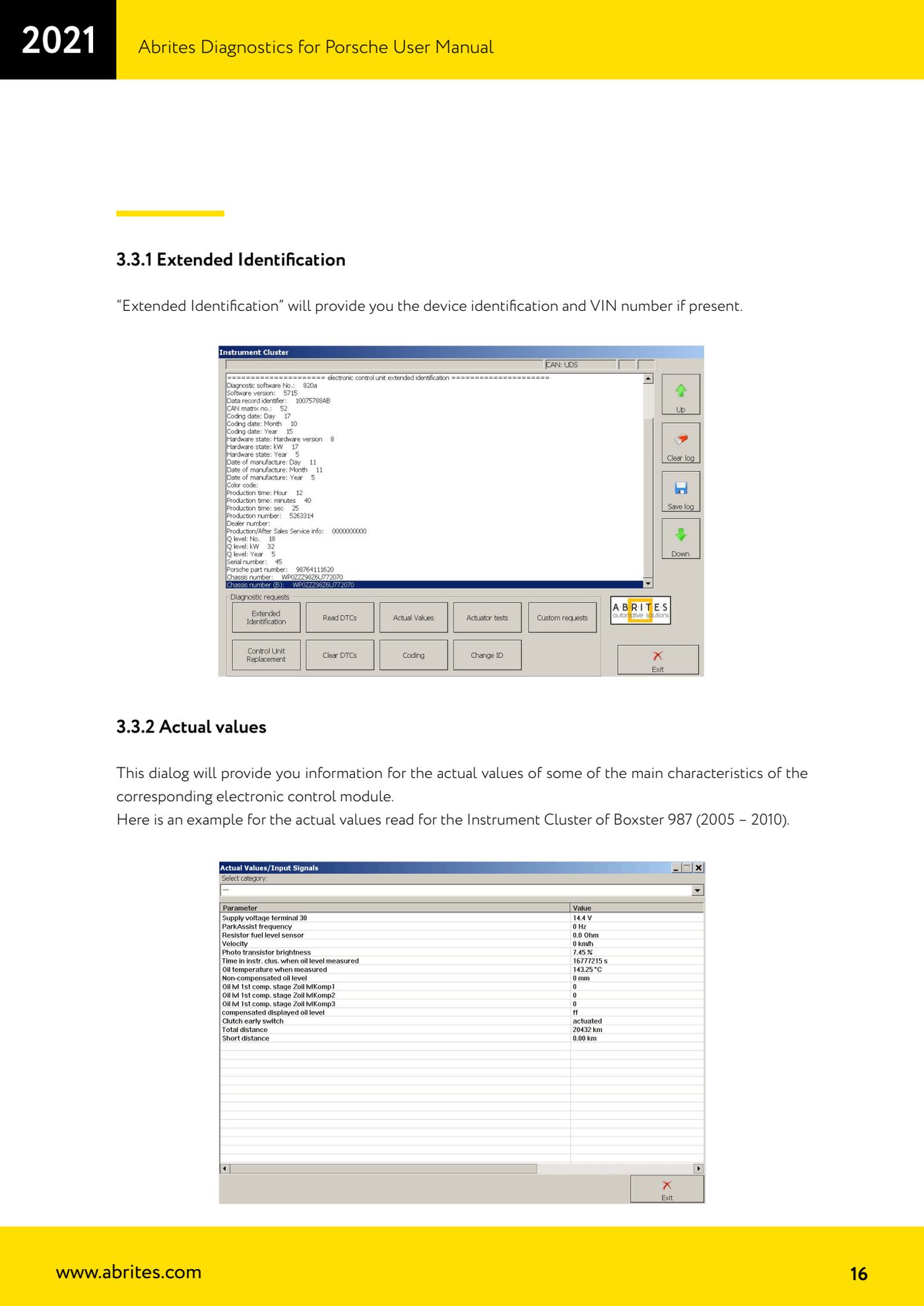
- Press "Actual values" to read the live values of the main parameters handled by that unit (typical example: Boxster 987 2005-2010 instrument cluster).
- Press "Read DTCs" to read the faults stored in the unit: the total number of DTCs present is also shown.
- After the repair, press "Clear DTCs" to clear all faults stored in that unit.
- If you want to clear faults on every reachable control unit, go back to the main screen and press "Clear all DTCs" in the "Broadcast" panel: the software connects to each unit and, if the connection succeeds, clears its DTCs.
- Run "Scan all" again at the end of the job to confirm the faults don't come back.
Reference screenshots
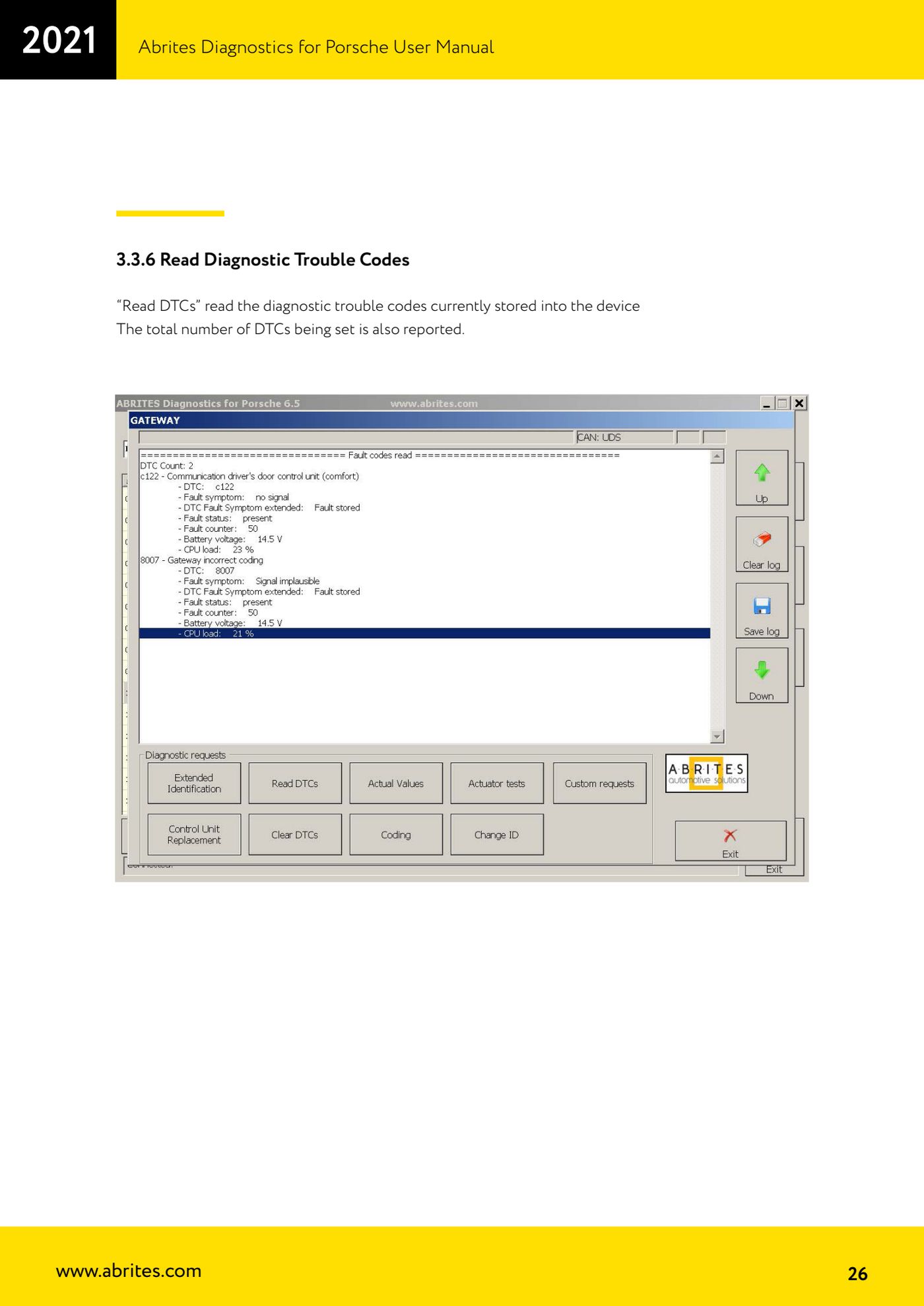
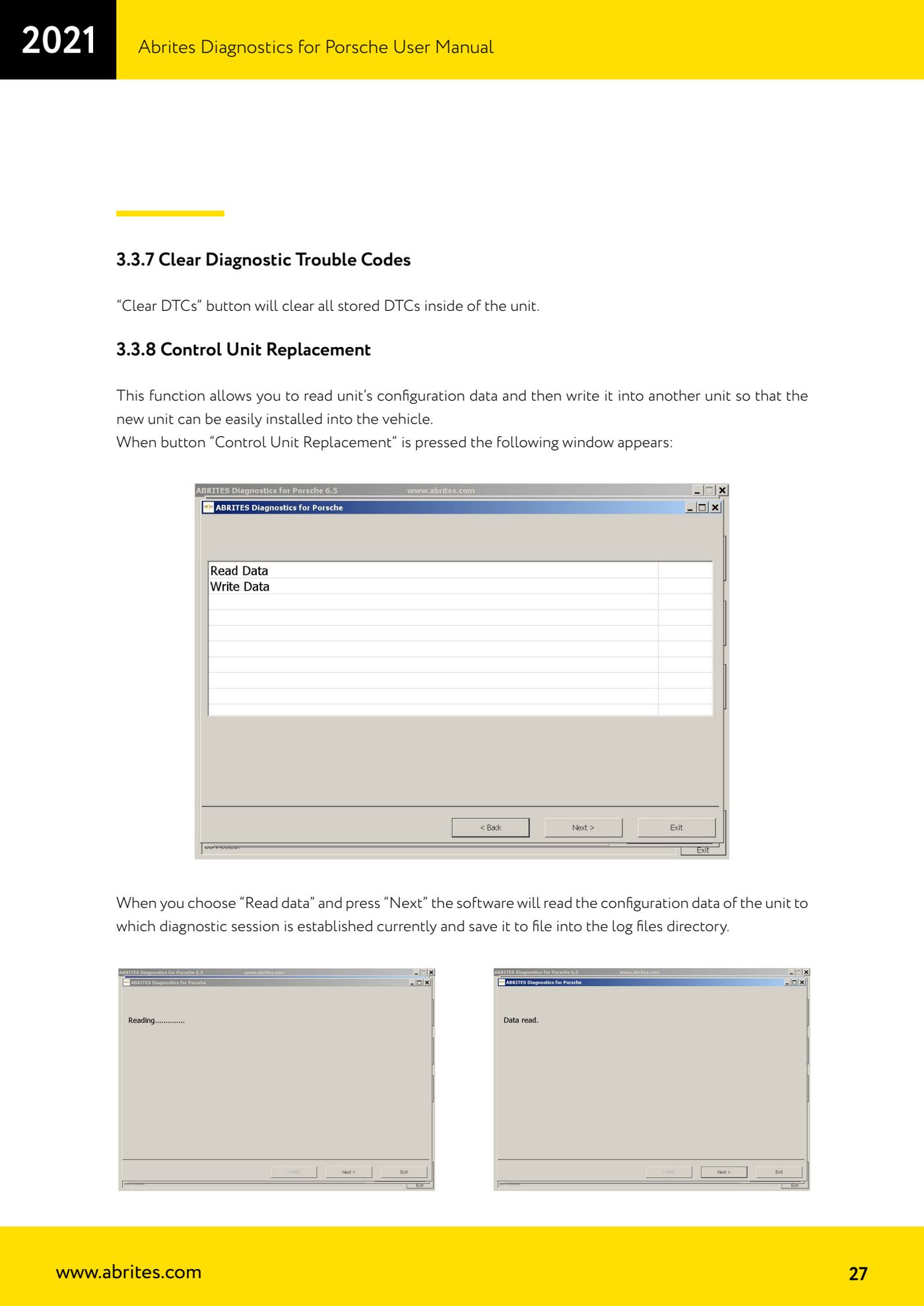
Source: Manuale Porsche (interfaccia classica), prima parte, cap. 3.2, 3.3, 3.3.1, 3.3.2, 3.3.6, 3.3.7 (p.14-16, 26-27) · ⏱ estimated time 10-30 min
← All Abrites guides Hardware catalogue
More guides Porsche
- Porsche software setup: protocols, K-Line baud rates, pins and CAN resistance
- Coding control unit options with "Coding - Settings" (Boxster 987 PAS example)
- Automatic coding, manual coding and restoring from file (UDS CAN TP units)
- Actuator tests ("Actuator tests") on Porsche control units
- Writing the VIN into a control unit with "Change ID"
- Control unit replacement: copying the configuration data with "Control Unit Replacement"
- CAN instrument cluster 911 997, Boxster 987 and Cayman: ConfData, mileage reading and cluster reset
- Service interval reset and oil level measurement: 911 997, Boxster 987, Cayman
- Reading and erasing the instrument cluster event memory (Instrument Cluster CAN)
- Service interval reset for Panamera, Cayenne 2011+, Macan, 918 Spyder, 911 991 and Boxster/Cayman 981
- Writing and changing the maintenance intervals: Panamera (2010-2012) and Cayenne (2011+)
- Cayenne K-Line instrument cluster: ConfData, ECU reset, service and mileage reading